Revenue is one of the easiest numbers for business owners to celebrate.
A new client signs. A large project comes through. Sales increase. The top line grows.
On the surface, that feels like progress. And sometimes it is. Revenue growth can be a sign that your business is gaining traction, building trust, and creating demand in the market.
But not all revenue is good revenue.
Some revenue strengthens the business. Other revenue looks good on paper but quietly strains cash flow, capacity, margins, and leadership energy. In some cases, the cost to deliver the work outweighs the value of the sale.
That is why growing businesses need to learn the difference between revenue that supports the business and revenue that slowly pulls it off course.
Revenue Is Not the Same as Profit
One of the biggest mistakes business owners make is assuming that more revenue automatically means a healthier business.
Revenue is the money coming in before expenses. Profit is what remains after the cost of delivering that work, operating the business, paying the team, covering overhead, and managing taxes. Cash flow is whether the timing of that money actually supports the obligations of the business.
Those are three very different things.
A business can increase revenue and still feel cash-strapped. A full pipeline does not guarantee profitability, and even a large contract can create a loss if the pricing, payment terms, labor, or scope are not aligned.
This is why revenue should never be evaluated alone. The U.S. Small Business Administration encourages business owners to use financial statements, including income statements, balance sheets, and cash flow statements, to understand the financial health of their business beyond surface-level activity.
Good revenue should improve the business, not just make the top line look better.
What Makes Revenue “Good” Revenue?
Good revenue is not just money someone is willing to pay you.
Good revenue fits the business model.
It has healthy margins, supports cash flow, and fits within your team’s capacity. It also aligns with the type of work your business is built to deliver well, without forcing you to lower standards, overextend the team, or take on unnecessary risk.
Good revenue usually has a few key characteristics.
It is priced correctly. The business is not just covering direct costs but also contributing to overhead, owner compensation, taxes, reinvestment, and profit. The SBA’s guidance on market research and competitive analysis is a helpful reminder that pricing should be informed by your market, your customer, your costs, and your competitive position.
It has clear scope. Everyone understands what is included, what is not included, and what happens when the client asks for more.
It has reasonable payment terms. The business is not acting like a bank for the customer by funding labor, materials, inventory, or subcontractors long before cash is collected.
It matches capacity. The work can be delivered without damaging service quality, burning out the team, or creating chaos in other parts of the business.
It supports the long-term direction of the company. The revenue is not pulling the business into work it does not want to become known for.
Good revenue creates stability.
Bad revenue creates noise.
What Makes Revenue “Bad” Revenue?
Bad revenue is not always obvious at first.
In fact, bad revenue often looks exciting in the beginning. It may come from a large client, a big contract, a recognizable name, or a high-dollar opportunity. The problem is that the financial and operational cost does not show up until later.
Bad revenue often shows up as:
A client that constantly pushes beyond scope.
A project with low or unclear margins.
A customer that negotiates price down but expects premium service.
A contract with slow payment terms that strains cash flow.
Work that requires special exceptions, custom processes, or constant leadership involvement.
Revenue that keeps the team busy but does not move the company forward.
This kind of revenue can be dangerous because it gives the appearance of growth while quietly reducing profitability.
The business looks busier. Sales look stronger. The team may even feel like things are growing.
But underneath that growth, margins are thinning, cash is tightening, and leadership is spending more time managing exceptions than building the business.
The Hidden Cost of Saying Yes
Every “yes” has a cost.
When you say yes to one client, one project, or one revenue opportunity, you are also committing time, labor, attention, cash, and operational capacity.
That means you may also be saying no to something else without realizing it.
- You may be saying no to a better-fit client.
- You may be saying no to team bandwidth.
- You may be saying no to improving systems.
- You may be saying no to higher-margin work.
- You may be saying no to the version of the business you are actually trying to build.
This is why revenue decisions are leadership decisions, not just sales decisions.
A full calendar does not always mean a healthy business. A booked team does not always mean a profitable business. A growing top line does not always mean the business is getting stronger.
Sometimes the most strategic decision you can make is to protect the business from revenue that does not belong in it.
When to Say No to Potential Revenue
Saying no to revenue can feel uncomfortable, especially for business owners who remember what it felt like to need every sale.
But as a business grows, discernment becomes part of leadership.
You should consider saying no when the margin does not work.
If the revenue does not leave enough profit after labor, materials, overhead, software, management time, and delivery costs, it may not be worth taking. A low-margin project can still be useful in certain strategic situations, but it should be a conscious decision, not an accidental one. The IRS generally frames business expenses around whether they are both ordinary and necessary, which is a helpful reminder that the cost side of revenue matters just as much as the sale itself.
You should consider saying no when the payment terms create cash strain.
If you have to pay employees, vendors, subcontractors, or inventory costs long before the client pays you, the project may create a cash gap. That gap matters. Revenue that does not convert to cash fast enough can create real pressure, even when the work is technically profitable.
You should consider saying no when the client does not respect scope.
Scope creep is one of the fastest ways for good revenue to turn into bad revenue. If a client expects unlimited access, constant changes, or additional work without additional fees, the project can quickly become unprofitable.
You should consider saying no when the work does not align with your business model.
Not every opportunity belongs in your company. Some revenue pulls you into services, products, markets, or complexity that distract from your core business. Just because you can do something does not mean you should build around it. A clear business plan can help owners stay grounded in the customers, services, pricing, operations, and growth strategy that actually fit the business they are trying to build.
You should consider saying no when the opportunity creates too much risk.
Risk can show up through legal exposure, tax complexity, insurance requirements, dependency on one customer, unusual contract terms, or a client relationship that already feels misaligned. Revenue should not require you to ignore red flags.
You should consider saying no when the opportunity will damage the team.
If the only way to take on the revenue is to overwork your team, lower quality, delay existing commitments, or constantly operate in emergency mode, the cost may be higher than the sale.
A Simple CFO Filter for Revenue Decisions
Before saying yes to new revenue, ask better questions.
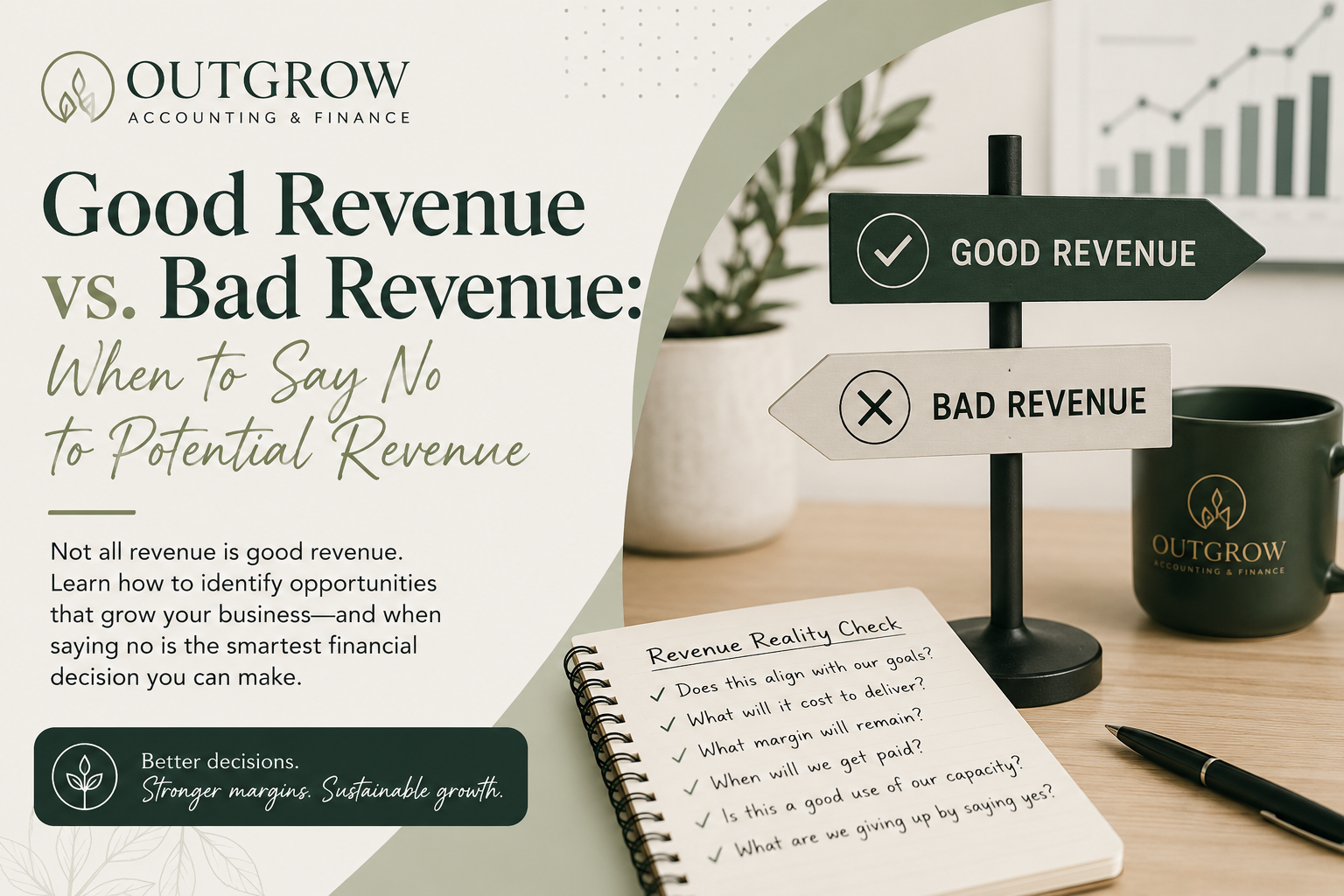
What will this cost us to deliver?
What margin will remain after direct costs and labor?
When will cash actually be collected?
Will this require additional hiring, overtime, inventory, equipment, or software?
Does this client or project fit the way we want to operate?
Will this create repeatable revenue or one-time chaos?
What are we giving up by saying yes?
Does this move the business closer to its goals?
These questions do not make a business less growth minded. They make growth more intentional.
Good revenue should pass through both a sales filter and a financial filter.
Sales asks, “Can we win this work?”
Finance asks, “Should we?”
The strongest businesses ask both.
Good Revenue Protects Margin and Momentum
Revenue is important. No business grows without sales.
But revenue by itself is not the goal.
The goal is revenue that turns into profit, supports cash flow, strengthens the team, serves the client well, and moves the business in the right direction.
A business does not become stronger simply because it gets bigger. It becomes stronger when growth is intentional, profitable, and sustainable.
That means learning to say yes to the right revenue and no to the revenue that distracts, drains, or destabilizes the business.
Sometimes the best financial decision is not chasing more.
Sometimes it is choosing better.
Final Thought
If your business is growing but cash still feels tight, your team feels stretched, or your margins are not improving, the issue may not be a lack of revenue.
It may be the type of revenue you are saying yes to.
The goal is better decisions, stronger margins, healthier cash flow, and a business that can grow without constantly running on pressure.
Leave a Reply