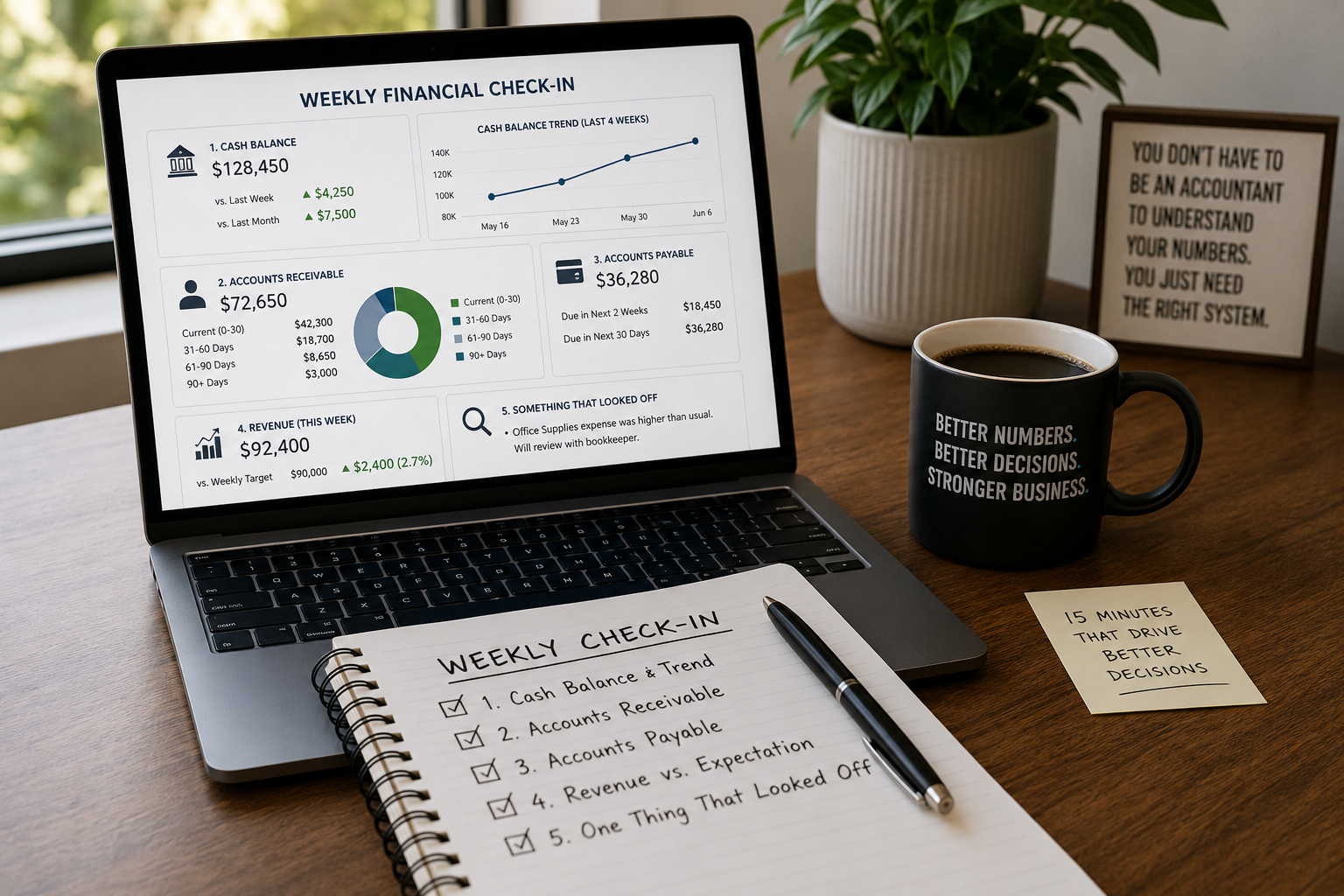
One of the most common things I hear from business owners is some version of this: “I know I should be looking at my numbers more, but I don’t even know where to start — and every time I open the reports, I either get lost or nothing makes sense.” That’s where a weekly financial digest can help clarify the key numbers and trends.
That is not a you problem. That is a setup problem.
Most accounting software was not designed for business owners. It was designed for accountants. The default dashboards, the standard reports, the way information gets organized — it assumes a level of financial fluency that most people running a business simply were not trained to have. And even if you understand the reports, reviewing everything every week is not a realistic or useful use of your time.
What you actually need is a short, focused weekly check-in. Not a deep dive. Not an audit. Just the handful of things that tell you whether the business is tracking the way it should — so you can make good decisions and get back to running the business.
Here is what that looks like.
Why Weekly — Not Monthly, Not Daily
Monthly financial reviews have their place. They are where you look at your full profit and loss statement, compare against your plan, and think about the longer-term picture. But monthly is too infrequent to catch problems early. By the time a cash flow issue shows up in a monthly review, you may already be in it.
Daily is the other extreme. Checking your bank balance every morning creates anxiety without insight. A single day’s balance tells you almost nothing useful about how your business is actually performing.
Weekly sits in the right spot. It is frequent enough to catch things while you can still act on them. It is infrequent enough that it does not consume the business. And when done consistently, it builds the financial awareness that makes every other conversation — with your CPA, your lender, your team — meaningfully better.
The goal of your financial review is not compliance. It is clarity. A weekly rhythm gives you that without requiring you to become an accountant.
The Weekly Check-In: What Actually Matters
1. Cash Balance and Trend
Start here, every time. Not because the bank balance is your most important number — it is not — but because it orients everything else.
Look at your cash balance today. Then compare it to where it was this time last week and this time last month. You are not looking for a specific number. You are looking at the direction. Is cash trending up, flat, or down? Is the trend consistent with what you expected based on how business has been going?
A declining cash trend in a strong revenue month is a signal. It might mean collections are slow, expenses have increased, or cash is leaking somewhere. It does not tell you which one — but it tells you to look.
If you have built a 13-week cash flow model, this is also where you check actual cash against your projection. The variance between what you expected and what actually happened is one of the most useful pieces of information available to you.
2. Accounts Receivable — What Is Owed and How Old Is It
This is the number most business owners undercheck and overpay for in stress later.
Pull your accounts receivable aging report. How much is currently outstanding? How much of that is current — meaning within your standard payment terms? How much is 30, 60, or 90 days past due?
A large receivables balance is not always a problem — it depends on your terms and your clients. But receivables that are aging without movement are a problem. They represent cash that should be in your account and is not. And the longer they sit, the harder they become to collect.
The shape of your receivables tells you something about your collections process, your client relationships, and the reliability of your expected inflows. A quick weekly scan keeps you from being surprised by a cash crunch that was actually visible weeks earlier.
3. Accounts Payable — What You Owe and When
On the other side of the ledger, look at what the business owes and when it is due.
You are not trying to review every vendor relationship. You are looking for anything significant coming due in the next two weeks that needs to be planned for — payroll, rent, large vendor payments, loan payments, estimated taxes. If something is due and the cash position looks tight, you need to know that now, not the day the payment is due.
This is especially important during growth periods, when more revenue often means more obligations arriving at the same time. Estimated tax payments are a classic example of an obligation that business owners know is coming and still get caught by — because it was not on the weekly radar until it was urgent.
4. Revenue for the Week — Compared to Expectation
Look at what came in this week. Not just in dollar terms, but relative to what you expected.
Were you on track with your sales targets or your project billings? Did anything close that you expected to close? Did anything that was supposed to close not happen? Are there invoices that should have gone out this week that did not?
This is not about obsessing over one week’s numbers. It is about maintaining awareness of the gap — or alignment — between what you planned and what is actually happening. When that gap widens, it usually means something needs attention. A client who went quiet, a pipeline that is thinner than it looked, a service line that is underperforming.
Revenue you can see clearly is revenue you can manage. The weekly check keeps you from being caught off guard by a bad quarter you could have seen coming in week four.
5. One Thing That Looked Off Last Week
This one sounds informal because it is. But it is genuinely useful.
Every week, as you review the above, something will occasionally catch your attention — a category of spending that seems higher than usual, a client balance that does not match what you expected, a number that does not reconcile with what you know about the business.
Write it down. Then either look into it yourself or flag it to whoever manages your books. Not every anomaly is a problem, but the habit of noticing them and following up is what separates business owners who understand their financials from those who review them without absorbing them.
Clean books make this easy. When your financials are accurate and current, anomalies stand out. When they are behind or disorganized, everything looks like noise.
What the Weekly Check-In Is Not
It is not a full financial review. You are not reading your entire P&L every week, reconciling accounts, or doing a deep analysis of margins. That work happens monthly — and it is important — but it is a different exercise.
It is not a substitute for your accountant or bookkeeper. The weekly check-in is you staying informed. It is not you doing their job. The value of accurate, professionally maintained books is that you can trust what you are looking at when you do this review. If your books are behind, the check-in loses most of its value.
It is not supposed to take an hour. If your weekly financial check-in is consuming significant time every week, the setup is wrong. The goal is 15 to 20 minutes with clear, organized numbers. If it is taking longer than that, something in your financial infrastructure needs attention.
Building the Habit
The hardest part of a weekly financial check-in is not understanding the numbers. It is doing it consistently.
Pick a specific day and time. Friday morning works well for many business owners — you get a complete picture of the week before the weekend. Monday morning works for others — you start the week informed and oriented. What matters less than the specific day is that it is fixed, recurring, and protected.
Use the same five items every week. Consistency is what makes the check-in useful. When you look at the same numbers in the same order every week, you build a baseline. You start to feel what normal looks like — and that intuition is what helps you spot something worth investigating before it becomes a real problem.
Keep a simple log. Nothing elaborate — even a note in your phone with the key numbers and any observations from each week. Over time, this becomes a useful record of how the business has moved, what patterns repeat, and which concerns resolved themselves versus which ones needed action.
The Bigger Picture
A 15-minute weekly financial check-in sounds simple because it is. But it is also one of the highest-leverage habits a business owner can build.
It keeps you out of the reactive cycle where you only look at your finances when something is wrong. It builds the financial awareness that makes every other decision — hiring, pricing, investment, debt — better informed. And it gives you the kind of confidence in your numbers that translates directly into stronger conversations with lenders, advisors, and anyone else who needs to understand your business.
What lenders actually look for in your financials starts with whether you understand them yourself. A consistent weekly review is the most direct path to that.
If your books are not in a place where a weekly check-in would give you reliable information, that is the first thing to address. Let’s talk about where you are and what it would take to get there.
Because the goal is never more reports. It is better decisions — made faster, with confidence, from numbers you actually trust.
Leave a Reply