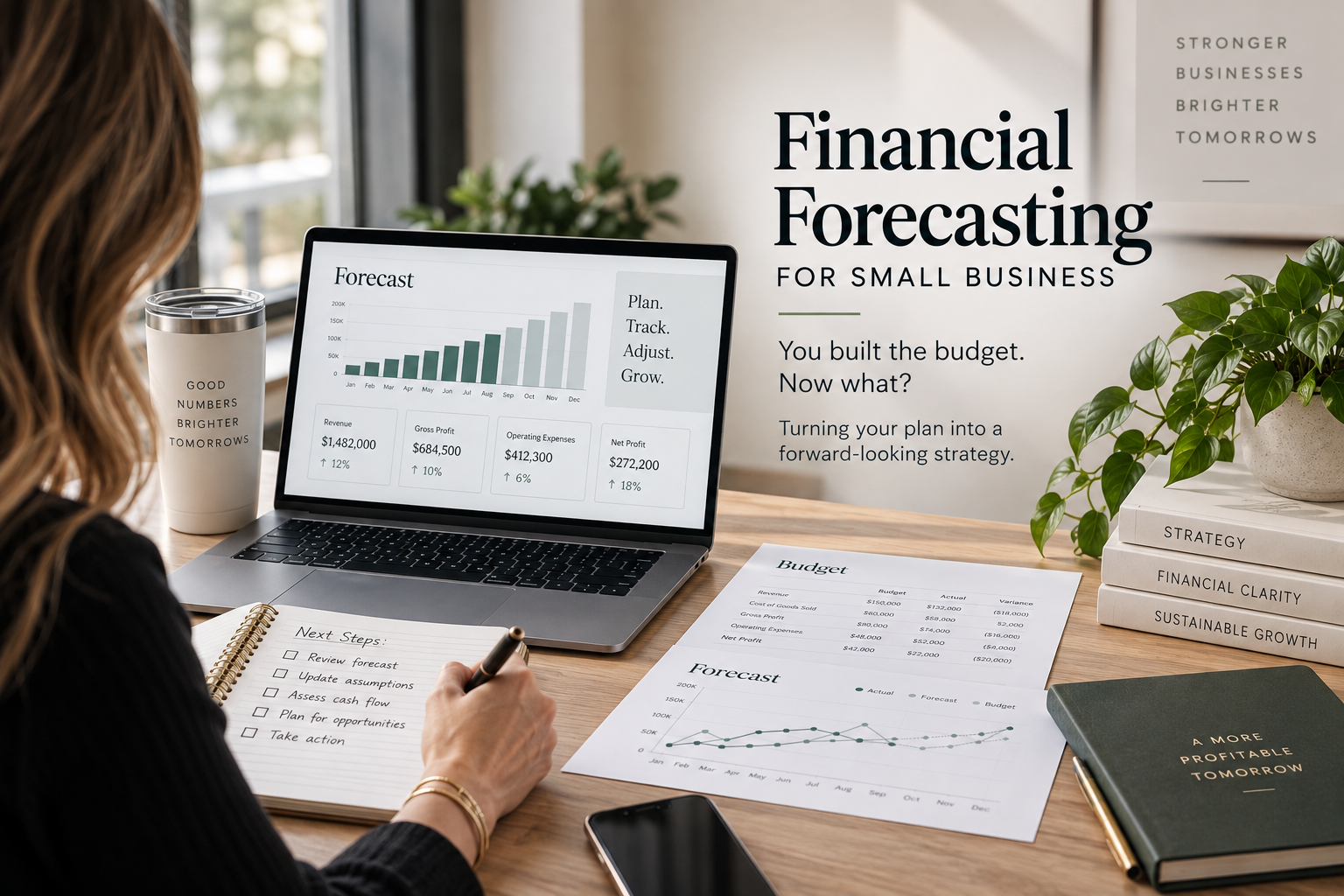
Earlier this week, we talked about why Q3 and Q4 are the right time to build your annual business budget. Today, we’ll dig deeper into financial forecasting for small business and how it ties into your planning process.
A budget gives your business a financial plan before the year begins. It helps establish revenue goals, expected expenses, hiring capacity, profitability targets, cash needs, and the assumptions behind your strategy.
But building the budget is only the first step.
Once the year begins, reality takes over.
Customers behave differently than expected. Hiring gets delayed. Expenses increase. Contracts change. Revenue comes in faster or slower than planned. Margins move. New opportunities appear that were never part of the original plan.
That is where financial forecasting for small business becomes so important.
A budget gives you the target.
A forecast tells you where you are actually headed.
If you missed our first article in this series, start with [why Q3 and Q4 are the best time to build your annual business budget] before diving into forecasting.
What Is the Difference Between a Budget and a Forecast?
A budget is the financial plan you establish for a specific period, typically the upcoming year.
A forecast is your updated financial expectation based on what is actually happening in the business.
The budget answers:
What do we want the business to accomplish?
The forecast answers:
Based on what we know today, where are we likely to land?
This distinction matters because your budget should remain relatively stable throughout the year.
Your forecast should change.
If your forecast looks exactly the same in June as it did in January, there is a good chance you are not using it the way it was intended.
Why Financial Forecasting for Small Business Starts With a Budget
Forecasting works best when you already have a budget in place.
Your budget becomes the baseline.
As actual financial results come in, you compare what happened against what you expected.
For example, imagine your budget assumes:
- $150,000 in monthly revenue
- $60,000 in payroll
- $25,000 in other operating expenses
- A 55% gross margin
Then January closes.
Revenue is $132,000.
Payroll is $63,000.
Gross margin is 49%.
The question should not stop at:
Why did we miss budget?
The more important question is:
Does what happened this month change what we expect for the rest of the year?
That is forecasting.
Budget vs. Actual vs. Forecast
These three pieces should work together.
Budget: What we planned.
Actual: What really happened.
Forecast: What we now expect to happen.
Your financial statements tell you where the business has been.
Your budget tells you where you intended to go.
Your forecast helps you decide what to do next.
That is why budgeting and forecasting are not competing financial tools. They are different pieces of the same financial strategy.
Why Financial Forecasting for Small Business Matters
One of the biggest benefits of forecasting is simple:
It gives you time.
And time creates options.
If a forecast shows that cash could become tight three months from now, you can begin making decisions today.
You may be able to accelerate collections, delay a purchase, adjust hiring, reduce spending, restructure debt, increase pricing, secure financing, or push harder on sales.
If you wait until the cash shortage actually happens, your choices become much more limited.
The same principle applies when things are going better than expected.
If your forecast shows stronger revenue, better margins, and healthy cash flow, you may be able to hire sooner, purchase equipment, increase owner compensation, pay down debt, or invest more aggressively in growth.
Forecasting is not just about identifying problems.
It also helps you identify opportunities.
Forecasting Helps Separate a Bad Month From a Real Trend
Not every budget variance means something is wrong.
That distinction is incredibly important.
Imagine payroll is $15,000 over budget this month.
If the increase came from a one-time employee bonus, it probably does not significantly change your outlook for the rest of the year.
But if payroll increased because you permanently added two employees, your annual financial expectations should change.
Revenue works the same way.
One slow month may not mean much.
Three consecutive months below budget could indicate that your original assumptions are no longer realistic.
Financial forecasting forces you to ask:
Is this temporary, or has something fundamentally changed?
That is a much more valuable question than simply asking whether you were over or under budget.
Forecasting Helps You Manage Cash, Not Just Profit
A business can be profitable and still run out of cash.
This is one of the most important financial concepts for growing companies to understand.
Cash can become strained because customers pay slowly, debt payments are high, inventory requires upfront investment, equipment must be purchased, taxes are coming due, or the business is growing faster than its working capital can support.
That is why financial forecasting for small business should not stop with the profit and loss statement.
For many businesses, we recommend pairing the operating forecast with a rolling cash flow forecast.
The operating forecast answers:
Are we likely to be profitable?
The cash flow forecast answers:
Will we actually have enough cash to operate?
Those are not the same question.
The U.S. Small Business Administration also provides resources around financial management and cash flow planning for business owners. [Link “financial management and cash flow planning” to a relevant SBA resource.]
Forecasting Makes Hiring Decisions More Strategic
Hiring is another area where forecasting creates tremendous value.
Business owners often hire when the team becomes overwhelmed.
Sometimes that hire is absolutely necessary.
But before adding a permanent payroll expense, the business should understand whether it can actually support the position.
Forecasting allows us to evaluate things such as:
- Expected revenue growth
- Gross margin
- Payroll burden
- Cash flow
- Break-even impact
- Ramp-up time
- Expected return from the position
Instead of asking:
Can we afford this employee today?
We can ask:
Can the business sustainably support this employee over the next 12 months?
That is a much better financial question.
Forecasting Helps Protect Gross Margin
Revenue growth is exciting.
But revenue growth does not automatically mean the business is becoming more profitable.
A company can increase sales while simultaneously decreasing profit.
For example, revenue may increase 20%, but if labor, materials, software, or other direct costs increase 35%, the business may actually be financially worse off despite generating more sales.
Forecasting helps you monitor whether costs are moving proportionately with revenue.
If gross margin begins declining, it gives you an opportunity to investigate.
Maybe pricing needs to change.
Maybe labor efficiency has declined.
Maybe vendor costs increased.
Maybe the mix of products or services changed.
The question is not simply:
How much revenue are we generating?
It is:
What is that revenue actually producing for the business?
Your Forecast Should Change
One of the biggest differences between a budget and a forecast is how we treat each one throughout the year.
Your budget should generally stay intact.
If you constantly rewrite the budget to match actual results, you lose the benchmark you created at the beginning of the year.
Your forecast should absorb the changes instead.
For example:
A major customer leaves.
Update the forecast.
A new contract is signed.
Update the forecast.
You hire three employees earlier than expected.
Update the forecast.
Insurance increases 20%.
Update the forecast.
A major equipment purchase gets pushed into next year.
Update the forecast.
Your forecast is supposed to evolve as the business evolves.
How Often Should You Update a Financial Forecast?
For many small businesses, quarterly forecasting is a good starting point.
For faster-growing or more complex organizations, monthly forecasting may make more sense.
Businesses with tight cash flow, rapid hiring, significant seasonality, debt obligations, or aggressive growth plans may benefit from more frequent forecasting.
There is no single schedule that works for every business.
What matters is that forecasting becomes part of your regular financial rhythm.
It should not be something you suddenly build because the business is in trouble.
It should help you see the trouble coming.
Your Budget Should Not Be Rewritten Every Month
This deserves repeating.
When actual results are different from budget, resist the temptation to immediately change the budget.
The variance itself is valuable information.
You want to be able to look back and say:
Here is what we originally planned.
Here is what actually happened.
Here is what we now expect.
That gives leadership a much clearer understanding of business performance.
If the budget changes every time reality changes, you lose that accountability.
Budgeting Gives You Direction. Forecasting Gives You Visibility.
A strong annual budget gives your business direction.
Financial forecasting gives you visibility into whether you are still headed there.
And if you are not, it gives you time to decide what needs to change.
At Outgrow Accounting & Finance, we believe financial clarity should go beyond explaining what happened last month.
Through [fractional CFO support], budgeting, forecasting, cash flow planning, KPI tracking, and budget-to-actual analysis, we help business owners understand where their companies are headed and what decisions may need to be made along the way.
That is why budgeting and forecasting should not be treated as separate exercises.
They are part of the same financial strategy.
Build the plan. Measure against it. Update your expectations. Make the decision.
Because financial clarity is not about predicting the future perfectly.
It is about seeing far enough ahead to make better decisions before the numbers make them for you.
Leave a Reply