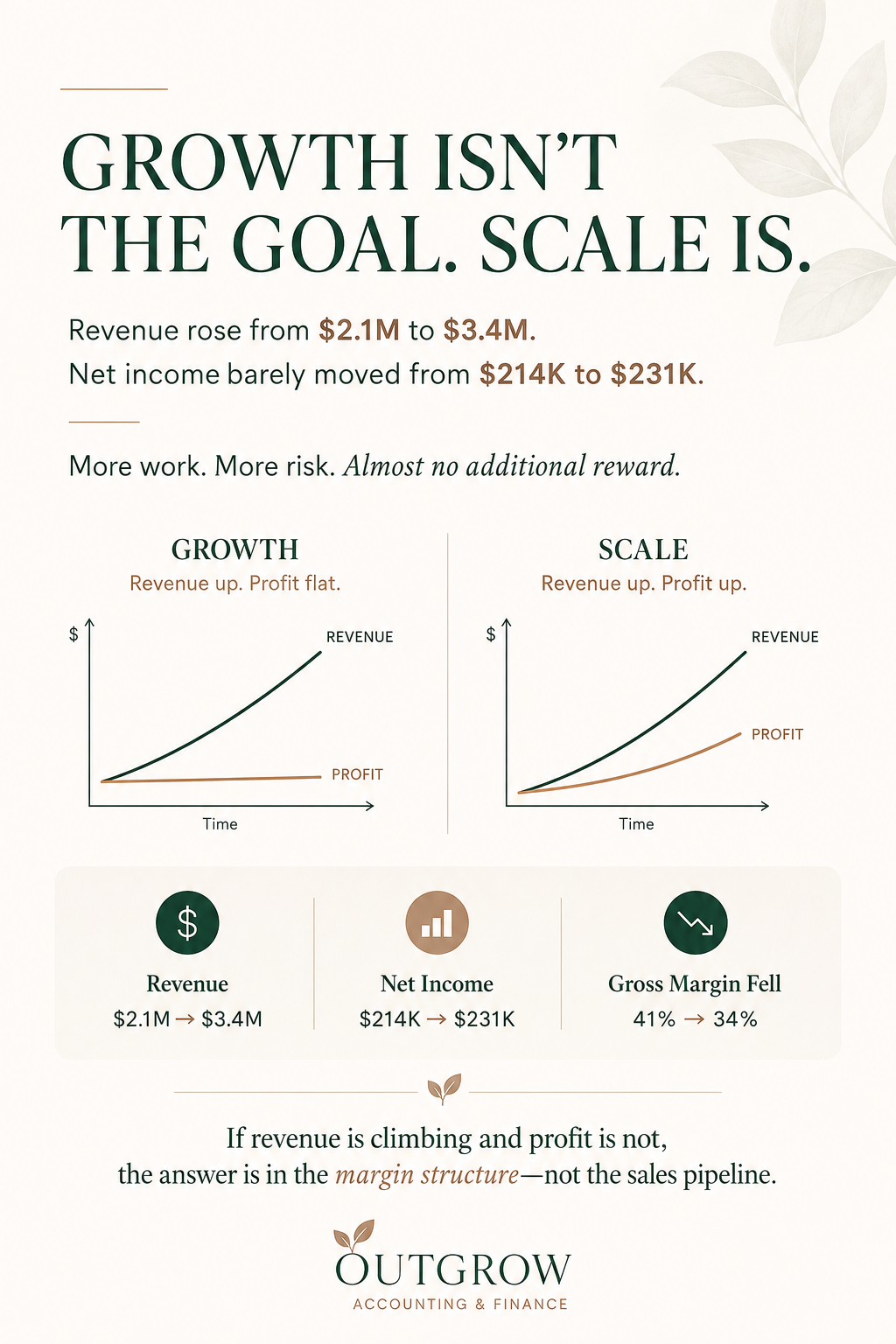
Revenue went from $2.1 million to $3.4 million. This change raises important questions about growth vs scale for any business.
Net income went from $214,000 to $231,000.
The owner worked harder, hired more people, took on more risk, and personally netted almost nothing extra.
This is one of the most common and most demoralizing patterns in small business, and it has a specific cause.
Growth means selling more. Scale means the cost of serving each additional dollar falls. They are not the same thing, and only one of them makes you money.
The Difference in One Sentence
Growth adds revenue.
Scale adds revenue faster than it adds cost.
A business can grow for years without scaling. It gets bigger, busier, and more fragile while the owner’s take stays flat.
The environment makes this harder than it used to be. In the Federal Reserve’s 2026 Report on Employer Firms, drawn from the 2025 Small Business Credit Survey, rising costs of goods, services, and wages was the most commonly reported financial challenge, while reaching customers and growing sales was the top operational one. Costs are climbing on one side and revenue is harder to win on the other. That combination squeezes margin from both directions, which is exactly the condition in which unexamined growth stops paying.
Where the Money Went
When revenue climbs and profit doesn’t, the leak is almost always in one of five places.
1. Contribution margin fell
The new revenue was less profitable than the old revenue. Discounting to win volume, taking lower-margin work to fill capacity, or accepting scope creep on fixed-fee jobs all do this.
More revenue at a worse margin can produce less gross profit than less revenue at a good one.
2. Overhead grew in step with revenue
Every new dollar of revenue required a proportional new dollar of cost — another coordinator, another license seat, another manager. If overhead is variable, growth just buys you a bigger version of the same margin.
Scale requires some costs to stay fixed while revenue rises.
3. Delivery got less efficient
Bigger teams, more handoffs, more rework, more supervision. Labor hours per unit of output creep upward and nobody measures it because the top line looks great.
4. The mix shifted
The high-margin service line stayed flat while the low-margin one doubled. Blended margin falls even though nothing changed within either line.
This is invisible without service-line reporting.
5. Working capital ate the profit
The profit is real. It is sitting in receivables, inventory, and work in progress. Growth consumes cash before it produces it.
This is where growth quietly turns into borrowing. The same Federal Reserve survey found that most small employer firms use financing on a regular basis, and among those carrying debt, a majority secured it with a personal guarantee. Funding working capital for growth that isn’t improving margin means putting personal assets behind revenue that isn’t earning its keep.
The Numbers That Show It
Here is the same business, before and after:
| Year 1 | Year 2 | |
|---|---|---|
| Revenue | $2,100,000 | $3,400,000 |
| Cost of delivery | $1,239,000 | $2,244,000 |
| Gross profit | $861,000 | $1,156,000 |
| Gross margin | 41.0% | 34.0% |
| Operating expenses | $647,000 | $925,000 |
| Net income | $214,000 | $231,000 |
| Opex as % of revenue | 30.8% | 27.2% |
Read that carefully. Overhead actually improved as a percentage of revenue — the business did get some operating leverage.
The problem is gross margin, which dropped seven points. Seven points on $3.4 million is $238,000 of gross profit that simply did not exist.
The business scaled its overhead and de-scaled its delivery. The second effect was larger.
Without the margin line, an owner sees only “revenue up, profit flat” and reaches for the wrong fix — usually cutting overhead, which was the one thing working.
Contribution Margin Is the Number to Watch
Gross margin at the company level is a start. Contribution margin by job, client, or service line is where decisions actually get made.
Contribution margin is revenue minus the costs that vary directly with that revenue: direct labor, materials, subcontractors, delivery-specific software, merchant fees, freight.
Every business should be able to produce:
- Contribution margin by service line
- Contribution margin by client, at least for the top 20
- Contribution margin by job or project type
- Contribution margin by sales channel
- Revenue per delivery employee
- Direct labor as a percentage of revenue, tracked monthly
Common finding: a meaningful share of revenue is delivered at or below breakeven, subsidized by a handful of good clients. Growth in the subsidized segment makes things worse.
Signs of Growth Without Scale
- Gross margin declining while revenue rises
- Headcount growing at the same rate as revenue
- Every new client requiring a new hire
- Owner hours increasing rather than decreasing
- Cash getting tighter as revenue grows
- Receivables growing faster than revenue
- Overtime becoming permanent
- Quality complaints rising
- No single job or client whose profitability you can state confidently
- The best people spending time on coordination instead of delivery
What Actually Creates Scale
Scale comes from a small number of structural changes.
Fixed costs that stay fixed. Systems, tooling, and management capacity that absorb more volume without proportional additions.
Standardized delivery. Repeatable scopes, defined processes, and templates. Custom-everything cannot scale because every job re-incurs its own design cost.
Pricing that reflects value, not hours. Cost-plus caps you at your own efficiency — every improvement you make gets handed straight to the client as a lower bill. Price against outcomes instead and getting faster becomes margin you keep.
Deliberate client selection. Declining work that does not fit is a margin decision, not a sales failure.
Utilization discipline. Knowing what percentage of paid delivery hours are billable, and managing it.
Technology that removes labor. Not software that adds a seat cost per employee, but software that lets the same person handle more.
Layered management. The owner cannot remain the constraint on every delivery.
The Diagnostic Questions
Before pursuing more revenue, an owner should be able to answer:
- What is our gross margin, and what was it twelve months ago?
- What is the contribution margin of our top five clients?
- Which service line is most profitable per hour of delivery capacity?
- What does the next $500,000 of revenue cost us to deliver?
- Which costs would stay flat if revenue rose 30%?
- How much cash does each additional $100,000 of revenue consume?
- What is our revenue per delivery employee, and is it rising?
- Are we turning down work? If never, are we priced too low?
- If we doubled, what breaks first?
That last question is the fastest way to find the real constraint.
Growth Can Make a Business Weaker
There is a version of growth that increases risk without increasing return:
- More clients, more concentration in low-margin ones
- More staff, more fixed payroll to cover in a downturn
- More debt to fund working capital
- More complexity, less owner visibility
- Higher revenue, thinner cushion
A $3.4 million business earning $231,000 is more fragile than a $2.1 million business earning $214,000. It has more obligations against nearly the same profit.
Bigger is not automatically better. It is only better if the economics improved.
The Bottom Line
If revenue is climbing and profit is not, the answer is in the margin structure, not the sales pipeline.
Find the contribution margin by line and client. Identify which costs are truly fixed. Determine what the next dollar of revenue actually costs to deliver. Then decide whether more revenue is the right goal at all.
Leave a Reply