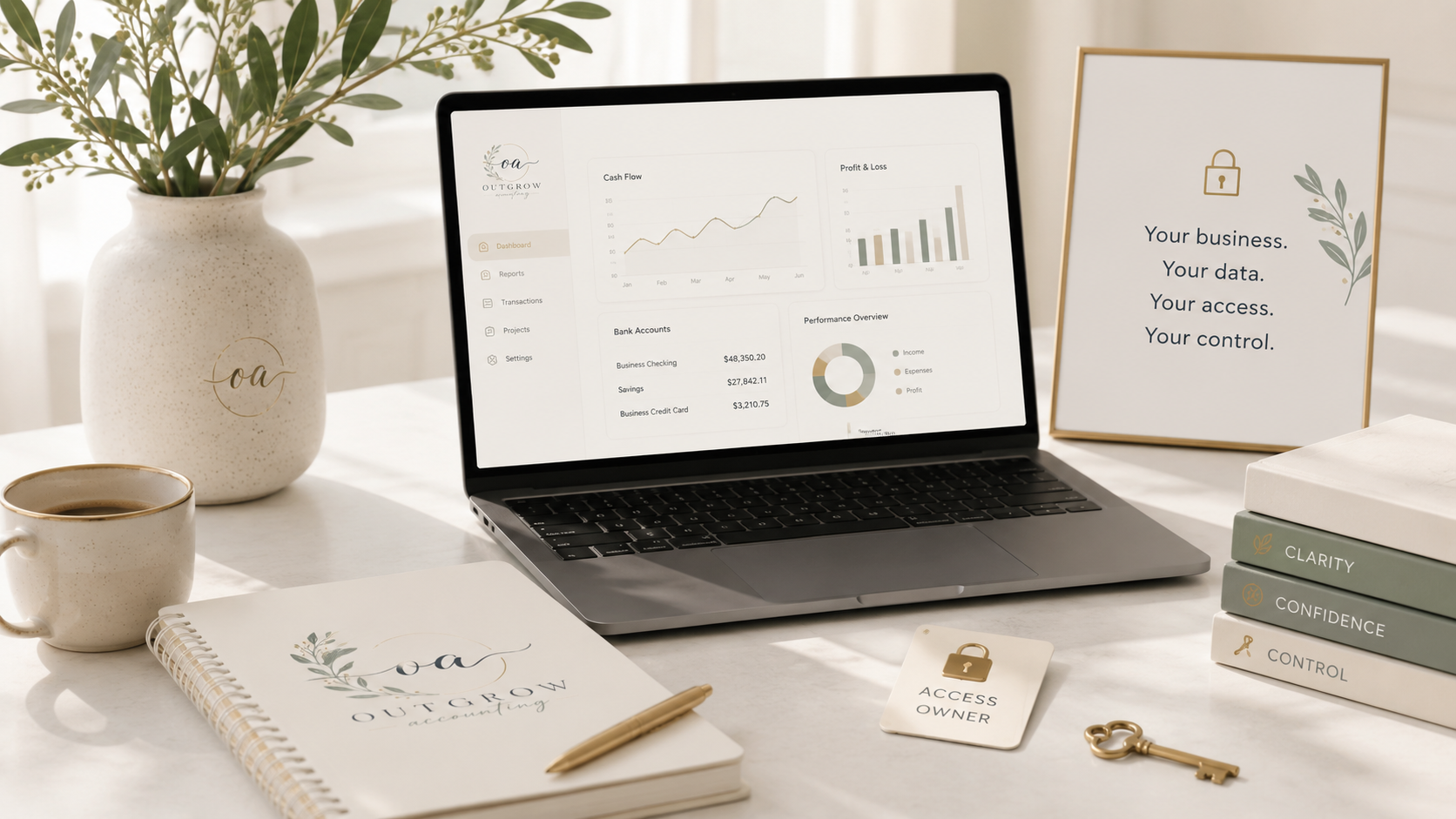
Outsourcing parts of your business can support growth. The right accounting firm, payroll provider, marketing agency, or IT partner can bring expertise, improve efficiency, and free you to focus on leading your company. However, it’s also essential to consider business software ownership as you decide what to outsource and what to keep in-house.
But outsourcing a business function does not mean surrendering ownership of it.
You can delegate the work.
You should still own the software, data, documents, processes, and administrative access behind that work.
A Real Example of What Can Go Wrong
I recently began working with a client who moved to Outgrow Accounting & Finance from another accounting firm.
The previous firm created and managed his QuickBooks Online account but never gave him direct access. Whenever he needed financial statements or information about his business, he had to request it from the accounting firm.
At first, the firm delivered the requested reports within a reasonable timeframe.
Then the response time started to grow.
The owner waited longer and longer for the information he needed to understand his company’s financial position. Eventually, the firm redirected him to a separate reporting platform where he could view limited information.
He still could not access the actual QuickBooks account that held his company’s complete accounting records.
He had outsourced the accounting work—but the arrangement also forced him to outsource access to his own financial information.
That distinction matters.
A reporting portal may offer convenience, but it does not replace direct access to your accounting software. A portal may display a profit and loss statement, balance sheet, or selected dashboard. It may not show the transactions, reconciliations, supporting documents, historical balances, or user activity behind those reports.
Your accounting partner may manage your books, but they should never control whether you can see them.
Your Business Should Own Its Accounting Software
Accounting software does much more than categorize expenses.
It holds the financial history of your business, including:
- Bank and credit card activity
- Customer and vendor records
- Accounts receivable and accounts payable
- Payroll information
- Loan and liability balances
- Reconciliation history
- Supporting documents
- Financial statements
- Tax-related records
- Changes made by users within the system
Your business owns that information—not the accounting firm that manages it.
Your company should remain the primary administrator of its QuickBooks Online account. Give your accountant or bookkeeping firm the access they need to perform the agreed-upon work, but keep ultimate control within the business.
At Outgrow Accounting & Finance, we may serve as the financial arm of a client’s company, but the client owns the accounting system and the records inside it.
Our clients invite us into their software to perform the work.
We never place ourselves between a business owner and their financial information.
Ownership Does Not Mean Doing the Work Yourself
Some business owners hesitate to retain administrative access because they hired an accounting firm specifically to remove bookkeeping from their plate.
Ownership does not require you to manage the daily work.
It gives you the power to:
- Log in and review your financial records
- Add or remove users
- Change accounting providers
- Download reports and documentation
- Confirm that your team reconciles the accounts
- Review activity within the system
- Protect your information when a vendor relationship ends
- Keep the business operating through a transition
QuickBooks allows businesses to transfer or change the primary administrator when ownership, leadership, or service-provider relationships change.
You do not need to reconcile every account or review every transaction.
You do need to control the system that holds the financial foundation of your company.
A strong accounting partner will support that structure—not resist it.
Own More Than Your QuickBooks Account
This principle reaches far beyond accounting software.
Your business should own and control the major systems, accounts, and records that keep it operating, including:
- Accounting software
- Payroll systems
- Bank accounts
- Merchant processing accounts
- Website domains
- Website hosting
- Business email accounts
- Cloud storage
- Customer relationship management systems
- E-commerce platforms
- Social media accounts
- Advertising platforms
- Business phone numbers
- Password management systems
- Vendor portals
- Standard operating procedures
- Internal documents and templates
A third party can create, organize, or manage these systems. The business should still appear as the owner or primary administrator whenever possible.
Keep subscriptions in the company’s name. Use company billing information. Maintain control over recovery email addresses, phone numbers, and authentication methods.
That structure allows your business to continue operating when a vendor relationship changes unexpectedly.
What Happens When a Third Party Controls the Account?
When a service provider owns your software or holds exclusive access, your business faces several avoidable risks.
You Cannot Independently Verify the Information
A financial report is only as reliable as the accounting records behind it.
Without access to the underlying system, you cannot easily confirm whether:
- The books include every bank and credit card account
- The accounting team completed the reconciliations
- Duplicate transactions exist
- Loan balances match lender statements
- Old balances remain on the balance sheet
- Accounts receivable accurately reflects what customers owe
- The books separate personal and business expenses
- Supporting documentation exists
- Someone changed or deleted transactions
- The financial statements capture all business activity
A PDF or dashboard cannot provide the same transparency as the accounting system that produced it.
When a provider limits your access, they ask you to trust the final report without giving you the ability to review the records behind it.
Trust matters, but strong financial controls should never rely on trust alone.
Provider Changes Become Harder Than Necessary
You should be able to change accountants, payroll companies, marketing agencies, or technology providers without losing access to your history.
When a third party owns the account, the transition can quickly become complicated.
Your business may need to:
- Request access from the former provider
- Prove ownership of the company
- Wait for someone to transfer the records
- Rebuild historical information
- Create a new account
- Export and import data
- Recover supporting documents
- Rely on the former provider’s cooperation
With a company-owned account, you can remove the previous provider and invite the new provider.
Without one, you may need to negotiate for information that should have remained under your control from the beginning.
A healthy provider relationship should support a smooth transition.
Your business records should never become leverage.
You Could Lose Historical Records
When a provider creates software under its own company name, email address, or billing account, your business may lose access when the relationship ends.
Even when you eventually recover the information, the delay can disrupt:
- Tax preparation
- Loan applications
- Investor reporting
- Payroll
- Insurance requests
- Audits
- Financial forecasting
- A business sale
- Due diligence
- Day-to-day decision-making
Your company may need its financial records years from now to support a tax return, lender request, audit, legal matter, or business transaction.
Know where your records live.
Make sure you can access them.
Limited Access Weakens Internal Controls
Internal controls do not belong only in large corporations.
Every business needs basic safeguards to protect its money, information, and decision-making.
When your company owns its systems, you can:
- Review access
- Add and remove users
- Trace changes
- Assign clear responsibilities
- Preserve records
- Prevent one outside provider from gaining unchecked control
- Maintain continuity during a transition
Third-party providers should receive only the access they need to complete their responsibilities. This follows the principle of least privilege and reduces the risk that comes with overly broad permissions.
The owner does not need to approve every expense or enter every transaction.
But the owner—or a trusted internal leader—should hold final authority over the system.
What a Healthy Third-Party Relationship Looks Like
A strong outsourced partner should make your business more organized, informed, and independent.
Before giving a provider access to a critical system, confirm the following.
Create the Account in the Business’s Name
List the business—not the service provider—as the account holder whenever possible.
Keep Primary Administrative Access Internally
The owner or a trusted internal leader should hold the highest access level and control user permissions.
Bill the Subscription Directly to the Business
When practical, pay the software provider directly instead of reimbursing the third-party firm.
Control the Recovery Information
Keep password recovery emails, phone numbers, and multifactor authentication methods under company control.
This matters most for administrative accounts and systems that contain financial, customer, payroll, or employee information.
Give Every Provider an Individual Login
Give each accountant, employee, agency, or contractor an individual user role with appropriate permissions.
Do not share the owner’s login credentials.
Individual access creates a clear audit trail, lets the company control what each person can see, and makes access easier to remove when the relationship ends.
Address Ownership in the Agreement
Your agreement should clearly state who owns the data, documents, accounts, templates, and work product created during the engagement.
The Federal Trade Commission also recommends documenting vendor security and data-handling expectations, including how providers will access, protect, retain, and delete company information.
Establish a Transition Process
Document how the provider will transfer records and remove access when the relationship ends.
Review Access Regularly
Remove former employees, contractors, and vendors from your systems promptly.
These safeguards do not prevent providers from doing their jobs.
They allow providers to do the work while protecting the business that hired them.
Questions to Ask Your Current Providers
You should be able to answer these questions about every critical business platform:
- Who owns the account?
- Who holds primary administrator access?
- Which email address controls password recovery?
- Which phone number receives authentication codes?
- Who receives billing notices?
- Can the company add or remove users?
- Can you access the complete history?
- Can you export the underlying data?
- Can you retrieve all supporting documents?
- What happens to the records when the relationship ends?
- Does each provider use an individual login?
- Does the system include every company account?
- Have you documented the transition process?
Review the arrangement now if you cannot answer these questions clearly.
Do not wait for an urgent transition to discover that someone else controls your business information.
Warning Signs Business Owners Should Not Ignore
Pay attention when a provider:
- Refuses to give the company administrative access
- Claims the owner does not need access
- Creates the account under the provider’s name
- Controls the recovery email address or phone number
- Delivers reports only through a limited portal
- Consistently delays financial statements
- Blocks the owner from reviewing underlying transactions
- Refuses to explain how they maintain the records
- Prevents the company from exporting its information
- Becomes defensive when the owner requests access
These warning signs do not automatically prove that the records contain errors.
They do prevent the owner from confirming that the information is accurate, complete, and current.
A healthy provider should offer transparency as part of the relationship. The owner should not have to fight for it.
Ownership Creates Stronger Partnerships
Maintaining ownership does not signal mistrust.
It creates a durable, secure, and transferable business that does not depend too heavily on one person or provider.
The best outsourced partners create clarity. They document their processes, provide visibility into their work, communicate what they are doing, and leave the business stronger than they found it.
They do not create dependency by restricting access. They create lasting value through expertise, accuracy, consistency, and strategic support.
At Outgrow Accounting & Finance, we help manage and strengthen the financial side of our clients’ businesses. We reconcile accounts, close the books, prepare financial statements, build cash flow forecasts, clean up historical records, and help owners use their numbers to make better decisions.
But the business remains yours.
So should the software, records, documents, access, and final authority.
Do You Control Your Financial Systems?
You should be able to access your accounting records without waiting for someone else to decide when you can see them.
Consistently delayed reports, provider-controlled accounting software, or limited access through a reporting portal may signal that you need to restructure your financial systems.
Outgrow Accounting & Finance helps business owners clean up their records, transition accounting systems, strengthen internal controls, and regain clear visibility into the numbers behind their businesses.
Because outsourcing the work should give you more clarity—not less control.
Leave a Reply